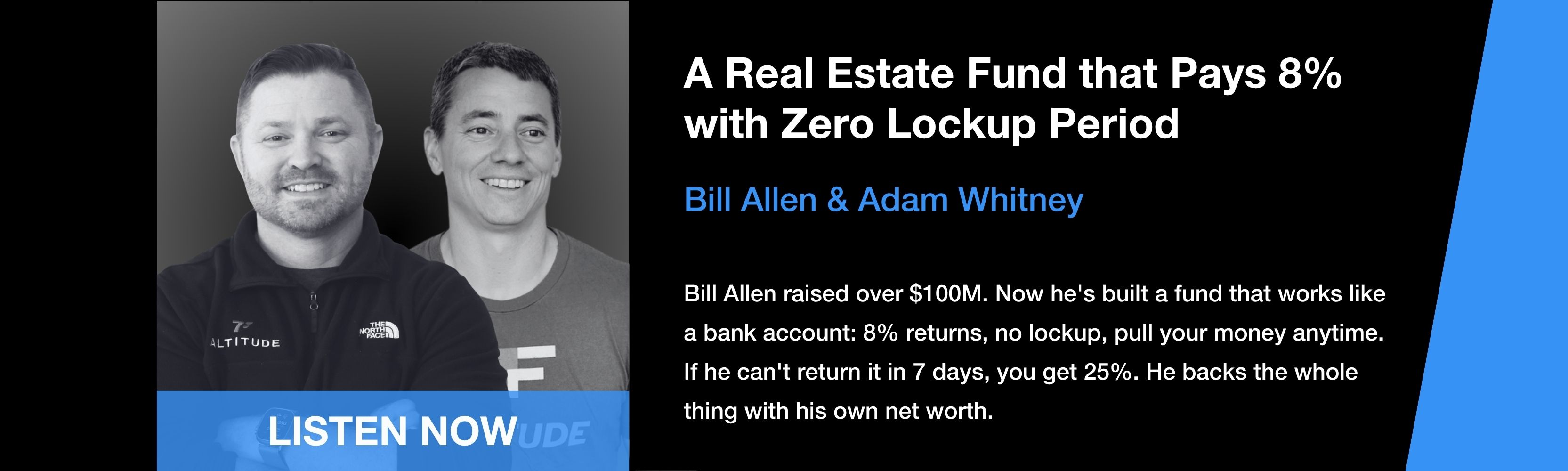
00:00:00 Speaker: Welcome back to the seven Figure Flipping podcast. I'm your host, Adam Whitney, and today's guest is my personal mentor and the president of seven Figure Flipping the owner of seven figure flipping. One of the best investors I personally know in real estate. Frankly, he's taught me mostly everything I know. So what a treat for you guys today. Bill, welcome back to your show, my friend. Yeah, it feels weird. What's up everybody. Welcome back to the seven Figure Flipping podcast. This is Bill Allen. It's like drilled into my brain for like three hundred shows maybe, I don't know, maybe five hundred. Thank you. It's good to be here. Okay. Bill. Bill Allen, owner of seven Figure Flipping, formerly the CEO, has bestowed that upon me. But my my personal mentor. And today we can listen to thousands of podcasts with you on it. But today I want to talk about the thing that I believe you're better than anybody in the world at, which is money. Factually money and in real estate. You know, with all of our hundreds of members, we're often talking about how to get more capital for our real estate deals, how to lend our money, how to raise money. And I know you're doing really unique stuff. You've probably raised, I don't know, one hundred million dollars plus to date, taught me everything I know, taught thousands of people everything they know. And I'm really excited to talk to you about what you're doing today with raising money and where you're employing money right now. But before we get into that, are there is there anything you've learned in the past two years about raising money and employing money that you think has changed in this space with today's market? Oh for sure. Yeah. Um, before I do that, like, um, the two things that I think are most important for a real estate investor investors. Number one, you got to have access to money. You got to have access to deals. Like, I really don't care if you're a wholesaler, a flipper, a builder, a land developer, um, Airbnb landlord, like whatever it is, access to deals and money, those two things, right? So there's like two arms, right? Two tracks of a, any real estate investor. Um, and I think most people struggle around money more than they do around deals. Like this is the number one thing I see most people have either a block with or something that's holding them back, right? So that's how important it is. Uh, money raising is a skill. It's very easy. And it's not even like you have to be a capital raiser, a money raiser. You just can be yourself just to start like it's, it's really easy. You got a network, you got people that know, like, and trust you. You start there and then you grow from the inside out, right? I think most people. So you asked what changed? I think when I got started, it was kind of like private money lending was more common. Like it's just we were talking about it a lot more, trying to figure out how to like, use other people's money that know, like, and trust us already to get started now. I feel like a lot of people just start with they go straight to hard money and they think one hundred percent hard money loan is going to take care of all their problems, and they don't need any other money. It's just not true. You still need that private investor or your own money. You need some gap, you need some some breathing room. So I would say what, what changed today? Um, probably there's a, there's more competition in the marketplace for people's money, I would say, than years ago. You got lots of other opportunities or places that they're putting money and the media is really loud about it. I think they have been for a while, but now it's you got cryptocurrency has been added since I started raising money. That wasn't even a thing back when I started. Um, you've got the stock market has been on a bit of a tear, you know, since twenty twenty since like the Covid dip, right? It's been on kind of a boom. So you got that, you've got, um, you've got a lot of the baby boomers that are reaching retirement age right now. So they're looking at maybe there's a different strategy that you can employ around raising capital for them because they're in wealth preservation more than wealth growth right now. A lot of them, um, you've got young entrepreneurs who are the AI boom and the internet. And not that the internet wasn't a thing, but you have these like young people that are making a crapload of money on social media, like TikTok influencers and people like that, making a ton of money and talking about it. YouTube has massively exploded. And so you've got a lot of different classes with money that you could be going after and noisy media. So, um, I don't think the fundamentals have changed at all. You know, the principles are exactly the same. Um, the strategy is, is changed a little bit and the tactics are, I look at the strategy being the thing that changed, like most of my tactics and my principles are still the same, maybe with a little bit different strategy. And that's probably what we should talk about today is what's the strategy in twenty twenty six to raise capital for your deals? So those are some things that I think have probably changed since, I don't know, the last fifteen years or so. Do you think what's your position? So I talked to a lot of the newest investors in the space. And the number one thing that they tell me is their obstacle to whatever their goal is in real estate is capital. Today, they literally the number one thing is, I don't know. I don't know if I have enough money, I don't know how to get the money. They think it's their number one problem. What would you tell the new investors coming into the space today about it? I would say it's not capital actually. It's your it's your belief that you'll be successful and you're like your mindset around accepting other people's capital so that if, if you're thinking about using your money and you haven't saved up enough money to get started flipping houses, like that's, that's number one problem. You don't actually need your own money to do it for sure. Um, I actually think flipping needs less of your own money than wholesaling. So wholesaling, I would not raise money for wholesaling business to for like marketing and operations. But when you raise money for a flip, you actually raise money against an asset that you actually own that you're adding value to. Now, I mean, you have to buy well enough. There's a whole bunch of like underwriting is another piece of it to make sure it's a good deal. But if you, if you think that nobody is willing to invest in you, um, it's probably that you just don't have enough confidence that you'll make money on that first deal. So that's what it is. It's actually the fact that there's plenty of money out there, believe me. And you're connected to it, you're tied to it. They will. They will invest in you. Um, for sure. But you have to have belief in yourself first. So I think that's really the challenge. Like the, the thing under, under the surface is really the fact that they just don't believe that they're going to be successful and make money, or they're unsure, or they're not confident that they'll do that. And without confidence, of course, you're not going to be able to go into any business meeting and have a conversation with somebody that has money in their bank account and then be like, excited to invest with you. Can you imagine if you came to me and I had one hundred and fifty thousand dollars that I was looking to, to do something with, to, to multiply, to grow. I want to invest. I'm busy. Professional. Right. And you came to me and you're like, I think I'm gonna make money on this deal. I'm not really sure. I've never done this before, but you should definitely give it to me. Like that's not going to go very well. But if you understand your numbers, if that's why I love what we do. If you have a coach, if you have somebody who can look it over, who can, you know, pour confidence into you to help you grow yours, then you go into that meeting feeling confident that this deal is going to be good. You're going to make money and then you're going to make money together. They feel confidence. That's where the kind of trust piece, right? They know you, they like you, but they also have to trust you. And so I think it's probably a lack of confidence is really the problem. It's not money. It's just it's, it's the lack of confidence, um, like portraying itself around money. Exactly. And, and what's, what's really interesting too. And I think before we talk about some ways that you're employing capital and strategy is, uh, the, the, the house space, the house flipping space, the rental space. Wall Street has poured billions of dollars into here hard money. So you we know there's a lot of Wall Street money competing for good deals today. But we're seeing this phenomenon where housing affordability is insane. So a lot of people are doing manufactured homes, at least in our world. We're doing all this scrape and replace stuff. Wall Street's not there yet. So there the cost to get hard money might be ten and one nine and one ten and two relatively inexpensive to use that money. We don't see that in the manufactured home space. There's only maybe four or five total lenders and they're fourteen and four, fifteen and five. Like it's crazy. They you have to know how to raise capital. And I, to your point, even when you're getting hard money, you still need additional gap funding. So I think that's really, really interesting in the space today for for strategy wise, because, you know, hey, before you ask the next question, that might scare somebody off who's like, well, I mean, there's a lot of money to be made in this scrape replacing these mobile homes that Adam you've been talking about for a while, but I'm not really there yet on my capital raising. And now that gives me an excuse because there's not a lot of like affordable hard money lenders in the space, right? So a lot of times that'll just say, okay, well, I'm just not going to do that now. That's where I want to. I want to really push the people that are listening to say, just learn how to go out and raise money. It's not hard. It really is not hard. And in fact, I can say that because fifteen years ago or so, it was twenty fifteen. So I guess we're like eleven or twelve years ago when I joined this mastermind seven figure flipping, I remember going in there and I started raising money and everybody else in the room, I'm talking about like twenty five other high level investors that were doing anywhere between twenty and like fifty deals a year. They, they weren't raising private money. They were struggling. They didn't understand how IRAs worked and solo for one, and self-directed accounts and things like that. And I just learned it and studied it and did it. And and I taught all of them to do it. It just like changed. So what I say is from the beginning, I didn't believe that this was very hard. It's not like, oh yeah, Bill, it's easy for you to say because, you know, you've been doing this for eleven or twelve years, raising private capital. Even in that moment, I was like, I got people all the time that are like, they hate their returns. They, they hate the stock market. They don't like the returns. They want more. So what I'm telling you is if you learn this skill, it will it will take care of you for the rest of your career. The earlier that you can just jump in and learn about raising money and just go out and do it. And the first time that somebody invests with you and you pay them back with a return and multiply their money, you will become addicted to it because it feels so good, and they never want to give it back to you or give it you to give it back to them. They always want you to keep it working and keep it working and keep it working. My investors stay with me for a very long period of time because we give great returns and we do what we say we're going to do. So I say that because if you can do that now, you have more of a blue ocean in the mobile home space like we've been talking about for a long time. And you have a skill that can then when that strategy has to change, I don't know, three years, five years, ten years down the road, you can just pick up your little money raising plan and move it somewhere else like I did. I picked it up from my houses. I moved it to apartments. Now I'm moving it to some new construction deals, and I'll move it to rental properties. And then I'll move it to raising money for businesses and I can move it wherever I want. So, um, okay, sorry, I'm off my soapbox. I just don't want anybody to have an excuse not to do what we're teaching them to do right now, which is go grab all the money that's out there just sitting on the ground in this affordable housing space. And I mean, it's really it's not that hard if you understand the system of raising capital. I remember this, you've told us and me and all the members so many times like you, you know, people with money, you just you, they don't know there's an opportunity. And I've watched so many people develop belief. I remember Ashley from our altitude group, this girl Ashley, she started putting videos on her social media, just kind of talking about what she was doing. And the the first person who invested with her was the secretary from her kids school. And they started with fifty grand and said, hey, if this goes well, I've got another two hundred thousand dollars. So you think about that like it's a secretary to school, maybe making fifty, sixty grand a year, and this person's got a quarter million dollars and believes in you and wants to invest with you. So it's it always cracks me up when people say, I don't know anybody with money. And I'm like, how do you know? The other piece is, over time, what's going to happen? And you'll be shocked. Like over time, people are watching what you're doing. And it might take I realize this might seem, uh, rough, but like you said, I had a, I had a guy I was flying with one of my early investors, first five investors. He had eight thousand dollars in his self-directed or his IRA and his wife had seven thousand dollars in their IRA. Like, there's no way that I would go through, jump through all the hoops that I did back then now to unlock fifteen thousand dollars for somebody, but got them set up in a self-directed IRA, deployed it to our company, Blackjack Real Estate. So eight thousand and seven thousand, fifteen thousand. That was gap funding for one deal that we did every time. So probably did three deals with that a year. So fifteen thousand paid about eight percent interest to them on fifteen thousand dollars, did three deals throughout the year and probably made between thirty and forty thousand per deal net profit to the company. So ninety thousand dollars with that, plus hard money for one year and paid eight percent of fifteen thousand dollars. You can do the math. That's probably like a thousand bucks, maybe one thousand two hundred. I want to read this real quick because I think I got a text message from somebody and, and then you got, you got those people that come in right away and you got the people that come in like way down the road. Like this guy I've known ever since I moved to Tennessee. He comes to our meet ups. He's an entrepreneur, he's got some money that just kind of sits there sometimes, and then sometimes he deploys it. We're going to talk about one of the strategies that I'm using now, but I'm paying eight percent interest in this fund. And he sent me this text message, and I'm going to read it to you because he said, PS yes, you can use this text in any marketing or quotes or videos for a testimonial. So I'm going to read it real quick. He said, bam, the Eagle has landed. Well, actually, the two hundred and fifty thousand dollars lands in the morning since we're past the wire cutoff. Well, after five years of knowing you, now you finally get some of my money. All those local meet ups at your office paid off. I feel like I could do your intro by heart for you. The funny thing is this two hundred and fifty thousand is just a small portion of the money you have helped me make over the years. We have a lot in common with family farms, faith flipping fun and pickleball and parentheses and funds. Our stories are linked more than you realize. And one day in the future years, I'll share more of those unique details I've met and believe in your team. I believe in your process and skill set. I believe you will take care of my money and not get over leverage. But most importantly, I believe in you. Bill Allen, thanks for all the education, guidance and inspiration over the years. I also believe that eight percent is a good a very good rate for an account that's very liquid. So it feels good to give these funds to you to invest. So I read that to you because five years, like I had, I have we've talked about doing deals together. We've talked about JV together. He's another real estate investor. And for five years we've just hung out like, I don't ask him for money. I don't tell him he should invest. It's on his timeline, not mine. But after five years, I get a message like that. And he's one of the larger investors in the fund that I'm going to talk about right now. He's he's twenty five percent of the capital that I've raised in the last month so far. So that's really cool to read. So you got both ends of that spectrum. When you're getting started, you've got the people that are going to watch like this girl Ashley, that Adam's talking about. They're going to watch those videos and maybe two or three years from now, they're going to invest. And then you get the people right in the beginning that you're just going to jump in like they're ready, they're ready to go. They've probably known you for a long time. It took a while for, for him to say, all right, you know, I trust in you. I believe in you. You're not going to get over leveraged. Here's my money. So it's really cool to have that experience. And it speaks to you being who you are. Like you said in the beginning, you just have to be who you are and be authentic and, and, you know, follow the golden rule. Follow the golden rule. Okay. I'd love to talk about strategy today, how that shifted for you. And I'd like to know both sides of this because you're, you're, you raise all this capital, you both are raising the money, but you're also employing it into good deals. So can you talk about how your strategy has shifted and how you're doing that today? Yeah, I I'm going to give a quick caveat. So I'm like a kind of a unique operator now. So I'm not as actively involved in like going to find, underwrite, negotiate all of these deals. And so most of what I do today is I work with other partners of mine to be the operational side of the business, and then I can bring the capital and some of the kind of guidance, mentorship, uh, run, maybe run some of the finance and personnel if I'm depending on what relationship it is and how long we've been together. So right now I've got, uh, blackjack. Real estate is an option that I can employ capital in. It's what Adam talks about on here all the time. Scrape and replace mobile homes, maybe fix and flips, um, rental houses, things like that. I've got another business with a partner that's kind of small. We might do like five or ten deals a year up in Kentucky. We just buy the houses, we renovate them, and then we put it, put a somebody in there and we owner finance, we sell it on owner financing. So that's a model where I've raised money into that, and then I've got some other partners in the multifamily space, or I'll raise money for a multifamily deal like an apartment. Adam and I just raised money for a new construction apartment in Texas with Jay Scott. Um, so I, we brought about a little over two million dollars to that deal, I think, if I remember right. And so I, in the beginning, I was kind of like just raising money for my fix and flip business, blackjack, real estate. So it was very easy. I say, hey, I can pay, you know, I don't know, eight to ten percent. It's on a balloon note. It's very specifically a fix and flip investor who is, who is a very specific avatar, like a very specific type of person that would want that kind of deal short term, six to twelve months. And that was it. And then I started doing the houses in Kentucky, and then I needed like money for like two to five years on interest only. That's a very different person. That's more like a baby boomer who wants to retire and wants monthly payments, right? So that's somebody else. And then you got the apartments who are like, you get a tax, a tax break on it. A lot of times it's going to grow over time, but you don't get hardly any cash flow and there's more risk. So like that's a different that's more like an entrepreneur who is making a bunch of money or other real estate professional that wants a write off. And so there's three different buckets I saw in the last like ten years of my growth is I have three different buckets. So now what was cool is I, I could bring kind of anyone in to one of those buckets that I talked to. So that was the strategy leading up to today. Now, the challenge I've run into is I have to educate all these people on what a fix and flip is and at the timeline and then what my owner finance homes are and what the timeline is on that and how it works, and then how the apartments work, and if they can use their tax break or all of it. I just got tired of being kind of like a mercenary to raise money. I'd be raising money here, and then I'd have to go raise money here, and then I have to go raise money here. And it was a game of whack a mole. I just was constantly like stressed out about it, raising money. So I wanted to find something that was just more easy for me. And a fund was always challenging because, uh, like a fund for the fix and flip any money that was idle or we weren't using. I wasn't sure that I could employ it all the time and lock up periods. And nobody really likes that. So it's, I wanted to make it really easy for somebody to come in and work with me and, um, and give them an option that's simple that they already know. So here's the problem. I have to educate all the people about real estate. Like that's the hardest thing is they have to feel comfortable. They understand the stock market. They understand the banking system. They don't understand real estate. And that's where our expertise is. But every time I had people that would, you know, invest money, I'd have to teach them something about real estate or we having these conversations or, oh, they're asking all these questions. So what I did, my strategy changed to say, well, what if, what if I could create like kind of like more of a money market account or like a, like a banking system that they already know? So if I took something that they know that they understand and I can just say it's kind of like that. So I can create this bridge from what they know to what I'm doing. And so I try to create this like bank money market, banking system effectively, where there's no lock up periods. They can just take their money in and out however they want. And it pays like probably double or more than double what they were making in, in a money market account or a liquid account, because everybody's got an emergency fund or some people just want turnkey eight percent. And then across the board, this is what you get paid. So that's kind of the new strategy is. And then what I can do is then I can take these funds and then I can deploy them into short term capital, mid term capital, and long term capital investments that I'm working on. Or I can use it how I see fit effectively as the, as the operator of the fund. So that is the strategy. Hopefully I explained it okay. But what I did was I just said, look, they're so comfortable with like how the banking system works. The banking system spends billions, if not trillions of dollars to educate people to, to learn about it, to put up a, a p r of four, three point five percent in their money market account. And all they do is they take your money and then they go borrow ten times more and they lend it back to you. So what if I could just, you know, give you a way better return to invest with me? So that's kind of the strategy. Hopefully I explained it right. But I basically built a bank that's really good. So your investors can invest in a fund that you said this, but I think I think you need to pull on this because a lot of times if you invest in a fund, it's for a purpose. It's it's being employed in a specific thing or you've heard of a blind fund, but you said something that makes this a little bit different. You said it's liquid. Yeah. What does that mean for the investor? So if I came to you and gave you twenty grand, fifty grand, one hundred grand today, when you tell me it's liquid, what does that mean to me? Well, so I just want to correct something. So we say this a lot if I give it to you. So you're not going to give me anything. Invest it, invest it. Invested in the fund, invested in the credit fund. Um, because if and again, this is like, yeah, if you give me something, I don't have to give it back to you. My goal is to, I have to give it back to you with, with a return. Right? So if you invested in our, in my fund specifically, it's, we call it a credit fund. And I named it the seven F credit fund. So effectively, and just so you know, this is a five hundred and six C fund, okay, five hundred six C so it's credit investors only five hundred six C um, it's a, it's a basically, I syndicated it. It's a, it's a reg D fund through the SEC, um, through a five hundred and six C portal. So accredited investors only inside the fund. And I can only take up to ninety nine investors inside this fund. So that's what it looks like. So I'm not as I talk about this, just so you know, that's my kind of caveat. All right. Um, so it's liquid what Adam said. What that means is you can take your money out whenever you want. And so that's the challenge for me to run the fund. So behind the scenes, the challenge that I have is if you can take your money out whenever you want, I got to make sure that I keep liquidity inside the the system, right? I actually have to have a system behind the scenes where if you, let's say you put one hundred thousand dollars in and I don't know, three months from now, you have a big emergency and you need to pull twenty K out to pay for something. I don't know, tree fell on your roof and you got to replace the roof for twenty grand. You can just go in there and request and do an ACH, twenty thousand dollars that goes back into your bank account. So there's no lock up period. It's not like, oh, you get less return if you don't keep it in there for six months, twelve months, eighteen months, five years, whatever that is, you can move it in, move it out. It's like I said, it's like, how do we keep it exactly like a, like a money market account effectively where you could just go grab your money if you wanted or. And the reason why I think this is so, so, so incredible is because now you've got I've got baby boomers, a lot of like my aunts, uncles, dad's friends and things like that. They want monthly payments, like they're living off their monthly payments on their returns. And then I got people who want to compound their money. They don't ever want to pull the interest out. They just want to let the interest grow and let it compound over time. So you can just say, you know, on the eight percent that I make on my one hundred thousand dollars every month, I'm going to take a draw for my interest. And you can just go in and take your draw. Just pull it out. It's that simple. You just say, hey, I want two thousand dollars to pay my credit card this month or pay my mortgage. And so my uncle, he invests and he just pays his mortgage every month on the returns that he gets. You can also leave it in. You could take out ten thousand dollars a month and draw it down. Um, it just gives a lot of flexibility for the investor. So from the investor side, it's incredible because they don't feel like they are handcuffed to you for the next three years. Most of these funds have long, long term lockups, eighteen months, twenty four months, thirty six months. And what they do is they bribe you to keep your money in there longer. So like, hey, if you sign up for three months, three years of lockup, I'll give you an extra one, one percent or two percent return. That's a typical typical fund like this. So that's from the investor side. It's really cool because it's, it's liquid. And the other thing that we haven't talked about yet is the minimum on this fund is one thousand dollars. So it's really low. I don't have to say yes, if somebody wants to come in with just a thousand bucks. But I also wanted to give the ability for people to put in a small amount and then add more over time when they feel more comfortable and see how the system works. So I put a minimum of one thousand maximum of two hundred fifty. I have the ability to say yes to more money than that, but a cap of fifty million dollars inside this fund. And so that's kind of the structure of of how it was built and how the documents are put together that. So we've got so you, I can invest with you get an eight percent return. I can, I can invest my cash with you get an eight percent return that I could pull out the interest every month if I wanted and leave the principal in and let it continue to grow. And if something happened, or you could pull out more, you could pull out more than you want. You can add money if you want. You can. And you log into your account and you every day you see how much interest you earned. It's right in there. That's the other thing that I think investors have a hard time with when they invest in our syndications or invest in our fix and flips is they're not getting a report every month. And the other thing I like to do, especially for the people that invest a lot of money, where the return looks really good each month is I will generate a report And I don't think my investors are doing that. So I'll generate a report for them and email it to them and just say, hey, here's your end of month report. It's in your account if you ever want to look at it. But I just wanted to send it to you and congratulations, you made three thousand two hundred and eighty four dollars this month as an example. You know, something like that. That's so cool. Yeah. So now now if people are watching this because we sometimes get people interested in real estate and then they realize, you know what, I'd rather just be a passive investor and I don't want to do the real estate work. So like, this is a really cool option for them where they don't have to be super real estate smart. That's why, that's why you're there to, to manage the fund. And what about other investors or who, what other investors would you invest with? Would you only invest this capital with? Where are you employing it? Would you only employ it with, you know, people like, you know, blackjack that you have relationships with, uh, in businesses? Or what else are you going to invest the money into? I'm sure both sides would have that question. Somebody's probably thinking, well, will you invest in my flips bill? Or if I invest with you, where are you going to put the money? Yeah. If you're listening to this podcast, I'm probably not going to invest in your projects with the fund. And so there's a couple of things to, to know. I, a lot of people are like, well, how is this fund secured? I'm personally guaranteeing the fund. So it has a personal guarantee against my net worth, which is really important to note here. Okay. So it's, it's effectively like a, it's built on a fund, a five or six C reg D syndication, uh, with SEC. Right. Uh, so there's a PPM that's, you know, I don't know, a hundred pages a little over that you read. It's got all the risks and everything like that. But it also states that I'm personally guaranteeing this against my net worth. So anybody who invest in my fund has full access to my net worth statement so they can see what I'm backing it with line by line. I have every item on the net worth sheet I updated about every month, and so they'll be able to see that against what I'm, uh, you know, kind of, um, personally guaranteeing this with it's a guarantee. And so from there. So now it's really important to me where I invest this money, right? Because if I don't, if I lose it, it's my money. Like I'm personally guaranteeing it. So if I lose your money, it's going to go against my net worth and it's going to drop my net worth. And I've had some bad experiences in the past with other operators. I've been investing with other people for probably ten years now. And, uh, I've, I've had some challenges. So I'm really, really careful about where this money goes. That's my main focus is, is preservation of the principle first. And I've, I've been running this fund for over a month now, and I've not invested in anything yet. So if everybody pulled their money out today, it would cost me about five thousand dollars of my own capital, not including all the paperwork that I had to use to create both funds. I have a B and a C fund. Um, so I'm in about thirty, forty grand right now that, that I'm putting up because this is a long term, very long term play for me. Like I want to get this fund to twenty five to fifty million dollars and be investing in long term assets down the road. Okay. So because of that, At, uh, you asked me what is the fund investing in? And so from an investor side, I'll say right now it's going to be very short term deals. So think transactional funding directly to a title company for a double closing and back. So if you have a double closing, I would be an investor with you today. So the fund could potentially invest with you. I would look at your purchase and sale agreement. On the buy side. I would look at your personal sale agreement. On the sale side, I would talk to your title company or your attorney, wherever you're closing the deal. And if you need to double close a deal, I will wire the money directly to the closing company. It will sit there until both sides of the transactions are done, and they'll wire it right back to me. You'll never touch it. It'll never see your account if it does. If the buyer doesn't come through, the money's going to come right back to me. It's in and it's out. I've done this many times and I've never been burned on a same day transactional funding deal. And so when you think about it from an investor side, okay, that's, that's a pretty safe avenue and short term, right? And then also it keeps your liquid, your capital liquid right now, when I'm still small. Okay, so that ten people call me tomorrow and they all want their money back. You know, they they ach it out. I've got to be able to get it to them because the way my fund works is it's eight percent returns. But if I can't give it to you in seven days, it's twenty five percent return. Wow. So that's how. And I could have said ten or twelve right when I wrote the documents. Think about it. I could say it's twelve percent. But what that does is it doesn't really incentivize me to actually make it liquid, right? Because now twelve percent, I'd be like, okay, well, it's twelve percent. I'll just keep it for another six months because I'm flipping a house with it. So sorry you're not getting it back. It would be counterintuitive to what I'm actually trying to build and I think ruin the integrity of the fund. So really interesting like structure of this, right? So from an investor side, we'll start with transactional funding. Then I'll likely go to some of our deals either in blackjack in my, um, my, some of my other fix and flips that I might do or like things like, like, uh, maybe some shorter of our, um, transactional type funding for some of our new construction if we need some liquidity for a couple months, but somewhere where it's like three to six months, right? So I got my one day, I got my three to six month timeline, and then we'll start going into some of our new construction projects or maybe some longer term fix and flips, or maybe a scrape and replace mobile home deal where we're somewhere around twelve to fifteen months potentially. And then and only once the fund gets to kind of critical capacity, might I invest in something that's longer term, like we just did for the three year project down in Dallas that I totally believe in. But you know, that money is invested for three to four years. So I have to have a lot of confidence that those investors are going to stay with me in the fund for three to four years, because that money's locked up. And so that's kind of how the growth of the. And then maybe, maybe I do some, um, maybe I might be investing in, uh, in some of the markets, like if we have some great opportunities in the markets, uh, maybe there's somebody that's about to IPO some inside information that I get, things like that. Um, and when I say insider information, like insider trading, but like, you know, hey, maybe, uh, anthropic being able to invest in anthropic before it, IPOs or something like that might put fifty or one hundred thousand dollars of the fund money in there. But what I do every month is I email out the this is where all the money is in the fund line by line. And every investor has access to my net worth document as well. Where am I putting my money? So. Um, and then the cool part is you got a choice. You can invest your money alongside the fund if you want. I'm underwriting deals. I'm sending it out to my investor list. You can get on that list and say, oh, this is awesome. Like he's investing in this, um, energy company. Um, maybe I want to get on the underwriting and I'll put my own money in there instead of putting it through the fund. Like that's okay too, you know, but it's not liquid like some of those deals lock up for two, three, four, five years and they have some level of risk, right? So all I have. So that's from the investor. Like if you're gonna invest into it side. Adam, I also want to answer your question from the the person who might build something like this or, you know, raising capital. So it's real. I showed you some of it. It's important for me to not just say, okay, I have a million dollars in there. Let's just go invest it in this apartment. Because the second somebody needs their money back, I'm under the gun. Right? And so if you're raising capital for deals, it's really important that you have a strategy of liquidity. So my strategy of liquidity here is at least twenty percent in the top two or the top two investors combined, whichever is higher of the fund. So right now there's about a million dollars in the fund. I have to keep at least two hundred thousand dollars liquid. However, my top two investors are about five hundred and fifty thousand dollars combined. So two people make up half of the money that's in the fund. And so I will not go invest their money because if both of those people need it back at the same time, I'm screwed. Right? So you need to really manage the money. So I wouldn't build something like this until you're really comfortable managing capital. So now I have about half a million dollars to make eight percent on for the whole amount of money, because everybody's getting paid every day. So what that means is I have to make sixteen percent or more. Like, it's not hard for us to beat eight percent. One transactional, probably if I do two transactional funding deals in a month, I'll make enough money to pay for the first two months of interest for this fund. So I'm being patient in the beginning. Just started this about a month and a half ago, obviously down the road, three, five years from now. I'll tell you how it went. I'm very bullish on this. I'm excited about it. And I think it's I think it's a great opportunity not only for investors, but also for me and the businesses that that we run together. So yeah, I'm I'm really excited for you. I've been watching the development of it. I just, it's going to be cool to watch those people get those returns, investing in that fund and then seeing your strategies going into different stuff. I get, you know, some I'm so blessed to have opportunities to just talk to you and see what your minds into these days. A lot of people. You got a lot of family listening to this, people you've known for years. And, um, how about just how do you see the market today? How do you what do real estate investors need to hear from you today? Twenty twenty six? You know, they're not in our community, but they've been listening to this podcast and listening to you for ten years. What do you what do they need to hear from you today? Because you're, you're seeing all these things happen with investors across the space. Well, number one, we built a community called seven Figure Runway in twenty nineteen, and it's evolved over time. And now it's a lifetime opportunity for you to join us if you're not in our community, the first thing I would do is join the community because the price is, what, half of what it was in twenty nineteen when I built it and it was just one year timeline then. So get in there and come join us and come along with us because there's way more information that is or come back, like come back for sure. Yeah. Jessica Bonetti I saw her. I was like, oh my gosh, this is so cool. Like, oh my. I mean, we've been on a wild ride since twenty nineteen, so, um, yeah, come back and see what we've done and what we changed. But that's step one is like, you just got to have, you just got to have a community and some people to bounce some ideas off of. That's it's always been my thing. Like I, there's no way I would be where I am right now without this company. And, and the twenty five people that were in that room, um, in December of twenty fifteen or January of twenty sixteen in, uh, the first meeting. So that's number one. Number two, where do I see it going? Like there's opportunity everywhere. And so, um, a lot of people are on the sidelines going, oh, now's not the right time to start in real estate. Um, you're, you're going to say you're can find an excuse for your entire life if you want to sit on the sidelines or you can find an excuse to get in. Um, there's always something, there's always a way to make money. You just have to find the inefficiencies in the marketplace. That's the key. And that's really what I'm trying to find with the fund, is inefficiency between the banking system and the inefficiency in me raising one off money. It's like, what? What are the people struggling? I mean, I have entrepreneurs in there and I have W-2 employees in there. Like everybody's like, yeah, this is very interesting. This is that sounds great. Like, I really like this concept. And now my job is to run it. So find your unique value proposition. What is the thing that you can do better than anyone else? And just jump in and, and, and find that. And I think, I think the affordable housing niche, this mobile home structure that we're talking about, it's, I feel like this is the, you know, twenty twenty six, twenty twenty seven gold rush effectively. So, um, I would say don't sit on the sidelines too long for that. Um, otherwise you miss the wave. So, but there's always an opportunity in, in everything. I mean, it's not just real estate, real estate, crypto, um, precious metals, stock market. If you just learn the system, you can win. Um, you just, and I'd say the third thing that I would say is just stay focused. Like, stop, stop bouncing around. So many people are like dabbling, like, stop being a dabbler. If you just dabble all around, you're not actually going to make any money. Um, you're going to just pay everybody for coaching. You're going to make a little bit of money, spend the rest on coaching. You're not actually going to build anything. Um, and then lastly, I would say anytime you do make money, create the excess, like spend less than you make and, and invest, invest the difference and just try, try to try to move those two lines, try to move the expenses down and move the, the, the income up and extend that. My whole military career was always about how do I get my expenses down? And I knew exactly how much money I was going to make every year because it's on the internet, you can look it up. But if I can get my expenses down and then over time, I'm going to make more money, then I can go from investing ten percent of my income to twenty to thirty to forty. And I was investing fifty five percent of my income at the at the peak of my, uh, single time in the military before I had a spouse and kids. And I just dumped it all in my IRA and my investment accounts. And then I was able to. When I found real estate and learned it, I was able to use that to go accelerate my growth in real estate. So, um, spend less than you make. Invest the difference, find a great spot for it. Um, yeah, there's a couple pieces of advice, but where's the market? The market's right where it is. And I think we all need to take advantage of it to do not sit on the sidelines. I don't care if it starts booming again. If it crashes, it doesn't matter. Like so many people made millions, if not hundreds of millions of dollars during the crash. Just, you know, just move fast. That's the thing. You have to move fast. You cannot be a turtle. Um. Get off the sidelines. Get off the sidelines. Create excess. Don't dabble those. I love those three points. I mean, I, I feel like I've been I try to say that every day to people just get focused. So I really appreciate that if people are interested because and I know people are going to listen to this and and they want to reach out about the fund. Or do you have a place for people to learn more if they want to invest in it or something? Um, yeah, I would say, you know, I don't have, I got like, I got a landing page. I think you can sign up there. It's really just for my, my people, but it's called, uh, Bill Allen flips dot com. That's like the main login for my people. I think you can like request a sign up there. Um, I, but we need to talk first. Like I'm, I don't want people's money in the fund that is just going to be there for a month or two and they're gonna, you know, ask, you know, pull the money back out. It really is kind of a longer term. Where does somebody park their emergency funds or things like that, you know, um, IRAs for one can use, you got to be accredited investor. So first thing we need to do is just have a conversation. So I'm totally cool with you guys emailing me. You can just email me. It's bill at seven finger flipping dot com. So Bill at the number seven finger flipping dot com, it's really creative. Um, and you can just email me there and say, hey, I'm interested. I'll send you a little bit more info. Learn a little bit more about you. Um, yeah. If we don't know each other, you absolutely have to be an accredited investor. So if you're not, um, it's a no go. It's just not like not even a start of the conversation. So, um, but if you're interested in that, great. And then if you're interested in like setting something like that up or some transactional funding, you need some same day double closing money. I'm your guy. I'm, I'm very cheap and very fast. And so I can, uh, I can talk to you about that. So that's kind of the, the deals that I'm looking for right now in the fund. And then as the fund grows, it'll, it'll look a little different. But right now, just really same day money for maybe a wholesaler needs to double close or in a city that you have to own it for a second before you, um, before you sell it, you know? So yeah, I think it's really cool if you're, if you're, if you're interested, it's worth reaching out and having a conversation of investing your capital. If you're as described, the right fit. You want to be in a long term play with somebody who obviously has a proven track record. You've been listening to this for a while. You know that I'd encourage you guys to reach out. I think it's I think it's one of the more interesting things today, especially with the economy and the stock market. I don't personally feel good about the stock market today because there's in my mind, there's no way, there's no way we don't have some type of correction on it. So I just, I like to get my stuff diversified a little bit. Bill. I think the other thing real quick, also, if you want to, if you want to learn about how I did it and do it yourself, I mean, it's going to take tens of thousands of dollars for you to do it. But I mean, I'm happy to talk about that. And if any of our members are listening, I know you guys listen to this podcast a lot. If you want to talk about it more at one of our events coming up, like our event in November or something like that, talk about some of the strategies. Just let us know. And I can kind of teach more of it and see if it's right for some of you to do too. So cool. I can say from, from me and from our community and from all the long time listeners. Man, we're still immensely grateful for you, brother. Like, we're immensely grateful for you to continue to show up for us. So, uh, thanks for coming back on to your podcast, man. Well, uh, I'm not gon like, if anybody thinks I'm gone, it's definitely not. Adam and I talk all the time. We talk way more about seven figure flipping than we do about anything else. So, um, and we've done a lot of kind of co-branded shows together in the past. So I'm grateful to be here. I love this place. I, I, there's no way I can get away from it. So and, uh, we're still, I'm still working in the background. I'm like, how can I teach more about money? How can that's a huge problem that we have. So hopefully you guys are, you have the five hundred K challenge, you have all the other stuff that we've done our money raising challenges and our events and, um, and inside the community, we still teach all the strategies and tactics and, uh, everything about raising money. So if you need help raising money, do not go to somebody else's like money raising mastermind. Uh, you can get that and everything else right here. So. It's absolutely, absolutely. Guys, if you like this show, first off, thank you Bill. If you guys like this show, I do need some help. I need more five star reviews so that we can reach more investors and impact more lives. So do me a favor. Whether you're on Apple or Spotify, go on there, click the review button. Leave us a five star review. I would be immensely grateful. And if you guys want to talk to Bill, we'll put his email and his link in the description. You guys can reach out about the fund, about money and all those cool things that we're doing. Of course, if you're in a real estate investor and you're in this space and you're not in our community yet, what are you doing? You need to be in our community. This is a ten year plus community with a proven track record. We've helped. We've changed so many lives in helping people build and scale their real estate businesses. We want to see you in here. You can click on the link below and we'd love to talk to you. Thanks for listening and I'll see you on the flip side.